Written on 27th March 2026
I ended up buying a Minidisc recorder. It was advertised as "Completely non-functional" but one of the photos showed battery corrosion (which I thought I could likely fix). Given the bargain price I thought I'd take a slightly impulsive gamble on repairing it, so bought it before someone else snapped it up.
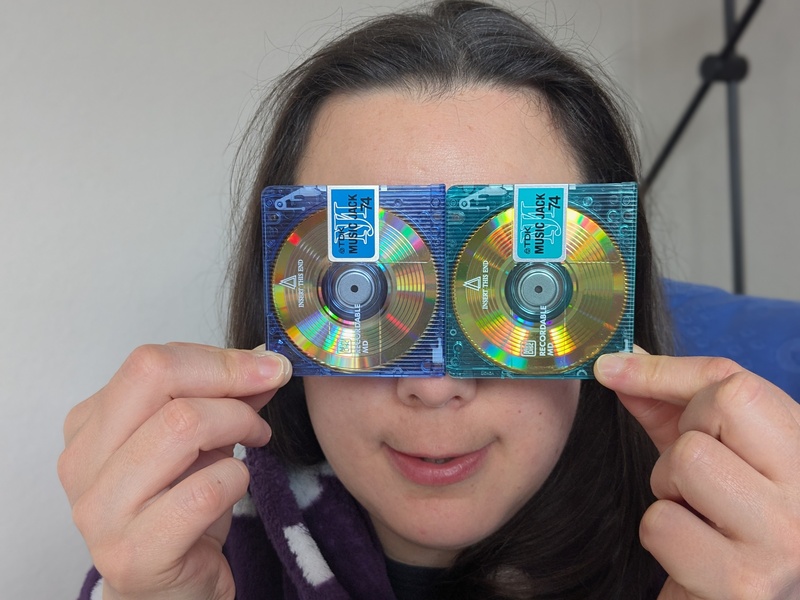 The advantage of minidisc: You can't be zany like this with streaming services.
I'm enjoying the 1990s retro-futurism of these small discs. I particularly like the graphic on the TDK XS-iV disk ("eXSess-iVe" - geddit?) - a stolen memory chip from our cyberpunk future, or something.
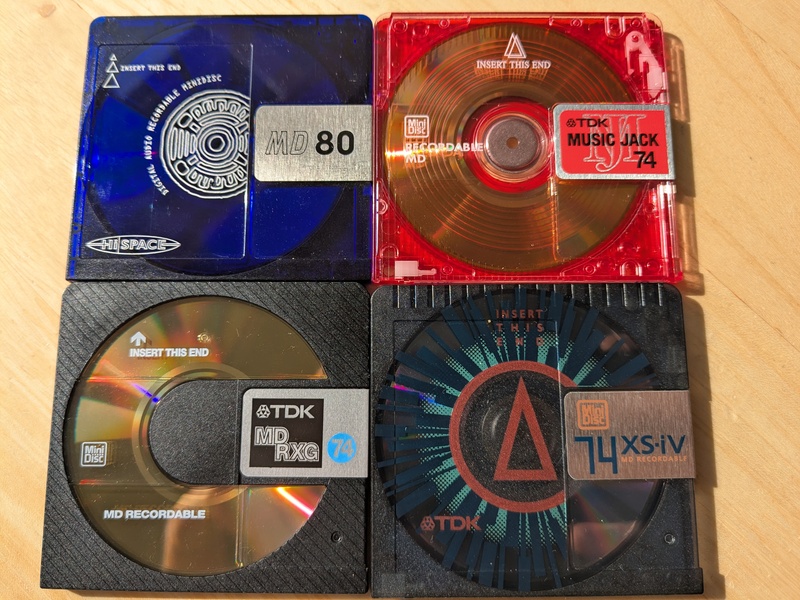
I like the colours and variety of designs and the way they reflect the light to make rainbows.
Repairing the Sony MZ-R91
The player arrived. I took the thing apart and tested it with my power supply connected to the circuit board. It came to life! This suggested that the obvious battery corrosion was the cause. We'd run out of normal vinegar, but had some red wine vinegar in the cupboard. The label said this would enhance the flavour. Enhanced flavour is obviously something you want in a battery terminal, so I figured it would be perfect to clean the contacts (in retrospect; maybe I was just hungry) - and it did.
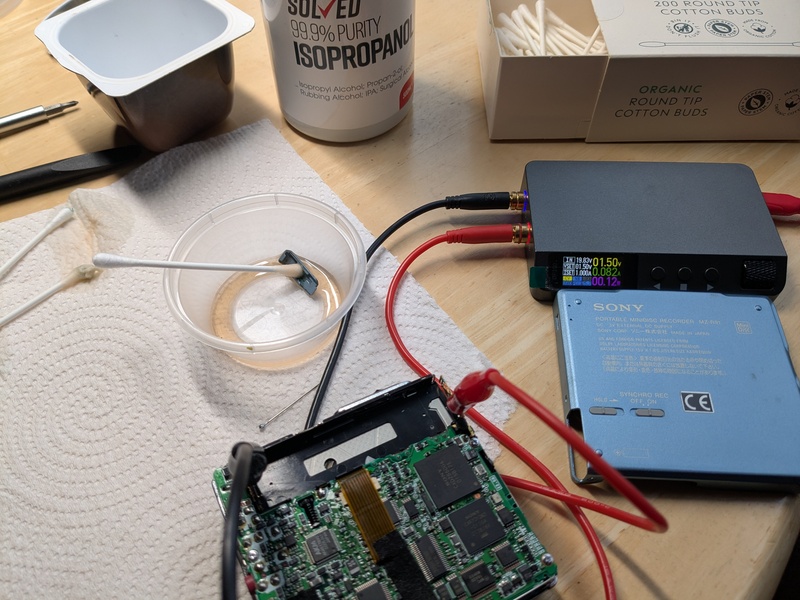
I made a little vinegar bath, and rinsed afterwards with isopropyl alcohol.
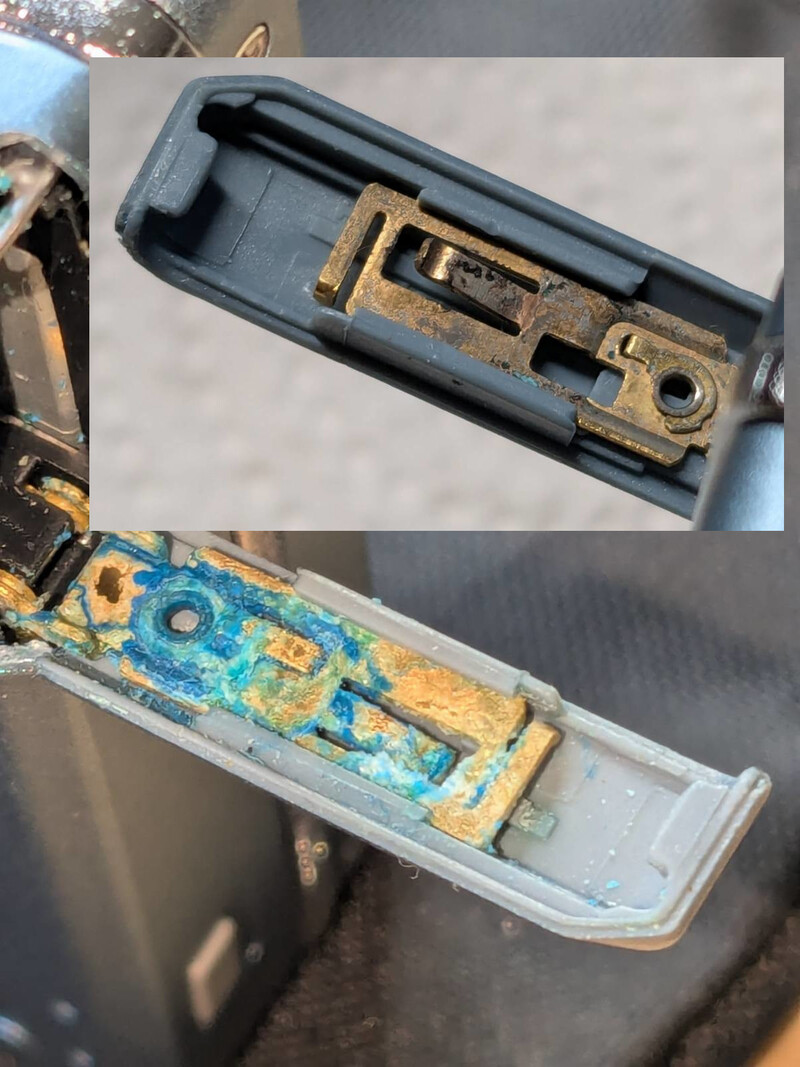 Before and after chemistry lesson: Blue + Vinegar = Not Blue. This was satisfying.
I took the thing apart, cleaned the internal contacts and it looks so much better. This player uses the small "Gumstick" batteries but has an external AA battery case. I did the same to the battery case, and the player works fine. Success!
It happened again: Repairing a Sony MZ-R70
At this point - I browsed online again (top tip: do not do this), and another player was available - and also at a discount price. This is rational. I can repair this one and pass it on. I got this one going, but the mechanism was noisy.
The Sony MZ-R70 service manual has detailed schematic diagrams and PCB layouts but has dire warnings about anti-static precautions for handling the laser assembly. I thought this was best done away from my wool carpet and lack of wrist-strap and anti-static mat - so I went to the Hacklab and disassembled it.
These things are tiny inside!
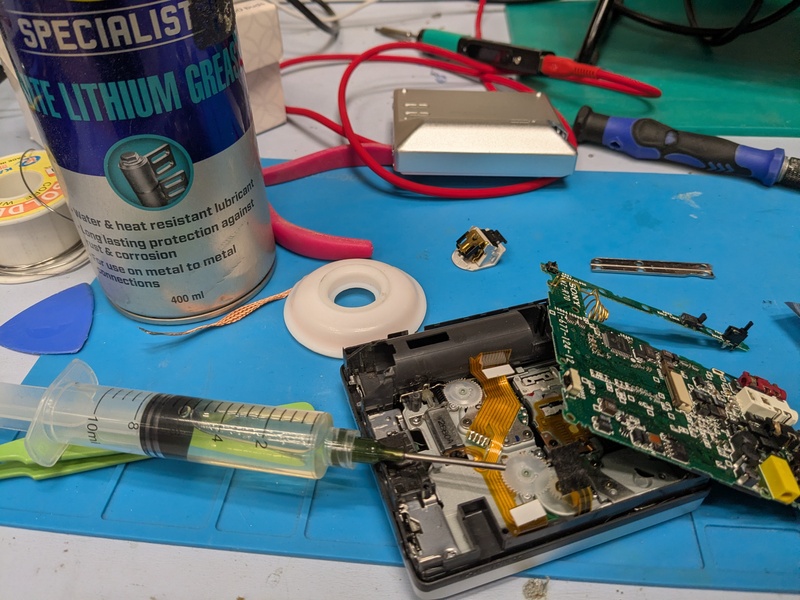
I used sewing machine oil to oil the motor spindle, and lithium grease to grease the moving laser/optical assembly. I can not say this was fun; it involved unsoldering a wire from the mainboard, and removing some awkward flat-flex connectors. Clearly the people in the Sony factory each had 5 miniscule hands when they built these things.
I had to remove a tiny circlip and no matter how careful I was it would keep moving away from my tweezers. This resulted in me dismantling more and more of the mechanism to try to retrieve the thing, as it fell deeper and deeper inside. Words were said as it teetered precariously on the edge of the bench, ready to fall and never be seen again. Fortunately - I got it all back together and wiped off my sweat.
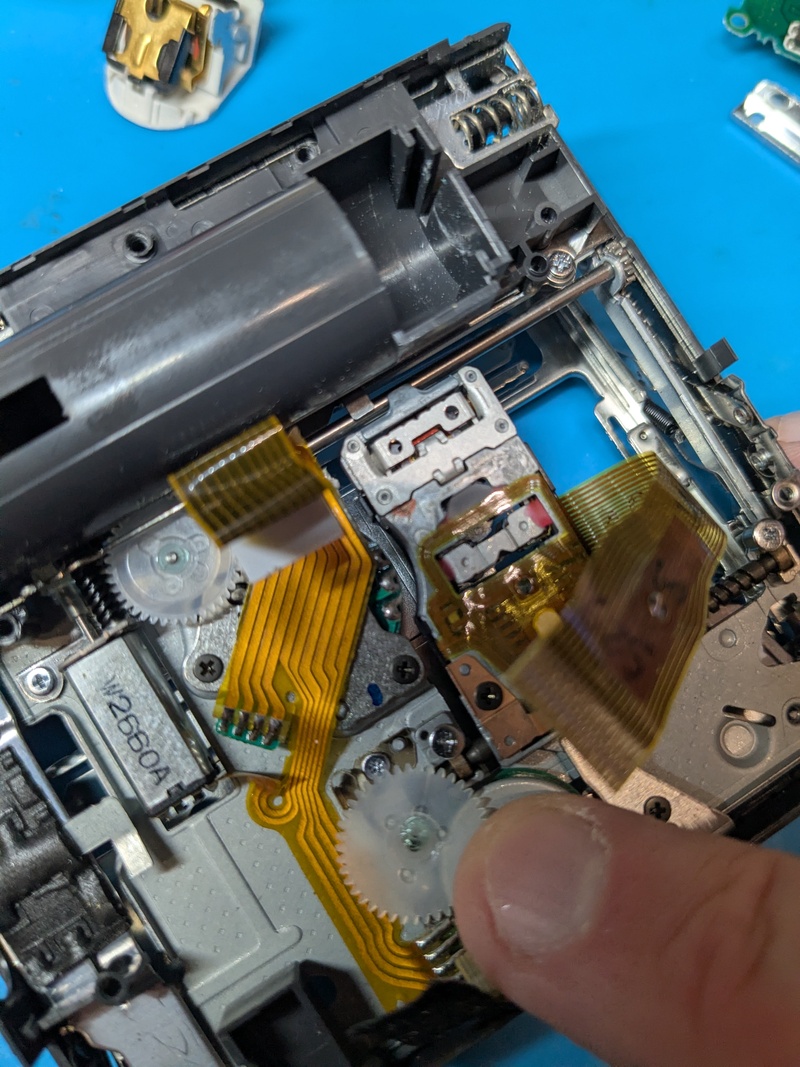 My nemesis: A transparent circlip a fraction of the size of my finger. Lesson: People with YouTube repair videos always make things look much easier than they are.
I wanted to remove the main motor to lubricate it, but this involved peeling back a flat-flex connector which was glued down. Given how easily these tear (and my nearly-losing-the-circlip stress) I decided to abort, and not risk it.
The player is much quieter now, but I still think needs a bit more work. Maybe another time I will try to do more, if I'm feeling braver.
NetMD
So - I pointed out above that I foolishly bought a second player. Fool me once…so I bought a third player. Doh. But this had a reason - NetMD.
My dad recorded a lot of concerts onto Minidisc and I wanted to archive them. Sony were always funny and worried about copy protection so never let you copy digitally off Minidisc (at least until the last few years).
Fortunately some people have made Web Minidisc Pro which is nice software. It uses WebUSB in the Chrome browser and allows you to copy files to and from minidisc without the cumbersome original Sony "Sonicstage" software. The hack is cunning - it uploads ARM machine code onto the player (The processor is an ARM7TDMI) which reads data from the disk, and sends it over USB - something Sony never intended. I like this kind of hack, and I'm able now to backup these music concerts.
Using Minidisc
I bought a 3.5mm to 3.5mm optical lead, which allowed me to record CDs digitally from my CD Walkman. There is no high speed copying, but I suppose waiting is half of the meditative process, or something.
I'm really liking these little players. There's something about the feel of the disk as it clicks in and ejects. I like the weight of them in my hand, and the precision manufacturing of the mechanism.
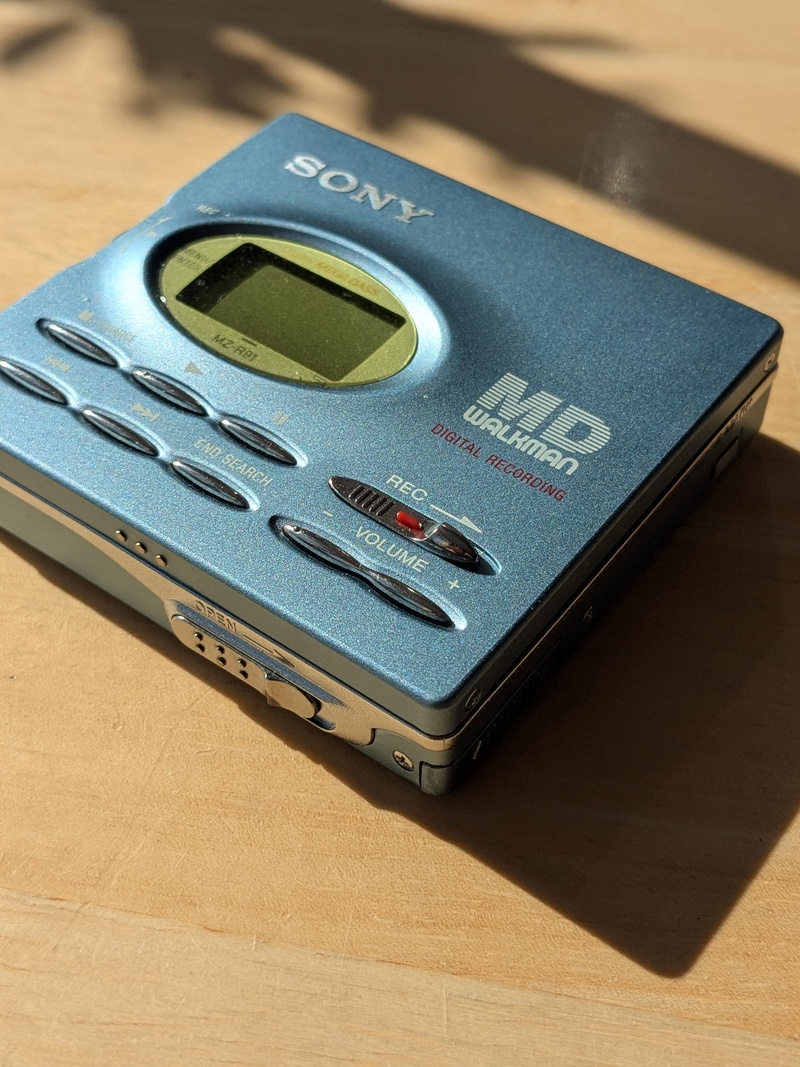
I'm not sure I'd like to travel somewhere with lots and lots of discs so I doubt this will replace my phone, but I think we've lost something very tactile in the move away from physical media.
Maybe we need a word for this. Something where the modern solution is much better in many ways, but we've lost part of our senses of noise, or touch, or smell for it.