The events in the US are upsetting to me just now. As a tiny antidote, I thought I would write a little story about how a bunch of us fixed something recently, and made a small but hopefully positive difference to our local community.
The Edinburgh Hacklab has a Sony amplifier which was donated years ago, but recently it developed a fault.
A hacklab which is unable to stream Radio paradise or SomaFM is no place at all, so we figured we should try to fix it.
There were conflicting reports: some people said it didn't work; other people said it was fine; someone said it didn't work but if you switched it on and off a couple of times it would be OK. This suggested an intermittent fault.
The Sony STR-DE697 service manual is available online so I reviewed the design for possible failure points. The circuit (schematic) diagram showed that the speakers were connected via output relays. Relays, being mechanical devices, can develop dirty contacts and fail in this manner so were the prime suspect.
An experiment showed that repeatedly pressing the "Speaker A/B select button" (which exercised the relays) could cause the sound to come and go, which added weight to the theory. The process of electronic fault finding is like a police drama, but without the drama or the police.
We opened the amplifier up to have a look. The relays could be seen, and hitting them with a screwdriver (a primitive, but tested debugging technique) would fix the sound when it was broken. They were definitely the culprits.
We needed to mend them, but the amplifier was covered in years of accumulated hacker dust and grime which was a bit - eww.
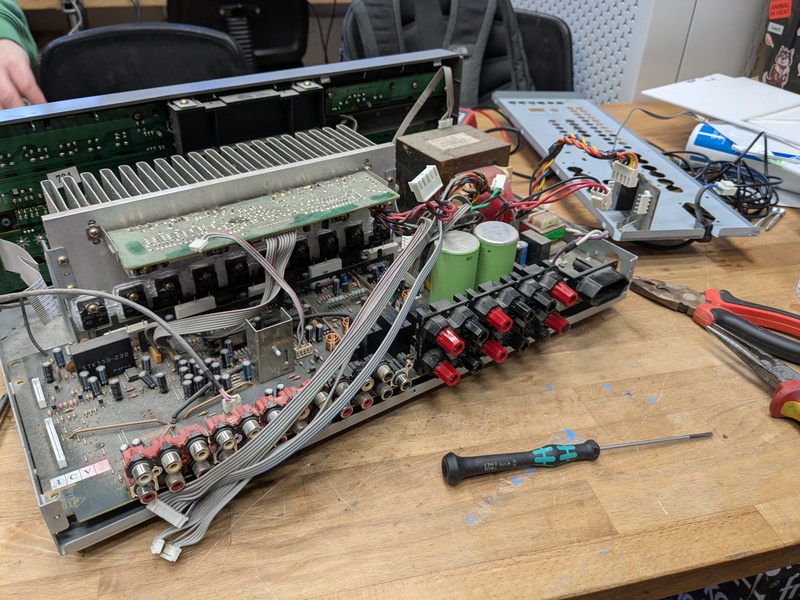
A few blasts from the air compressor in the Hacklab workshop dusted this away, making the circuit board look pleasantly brand new.
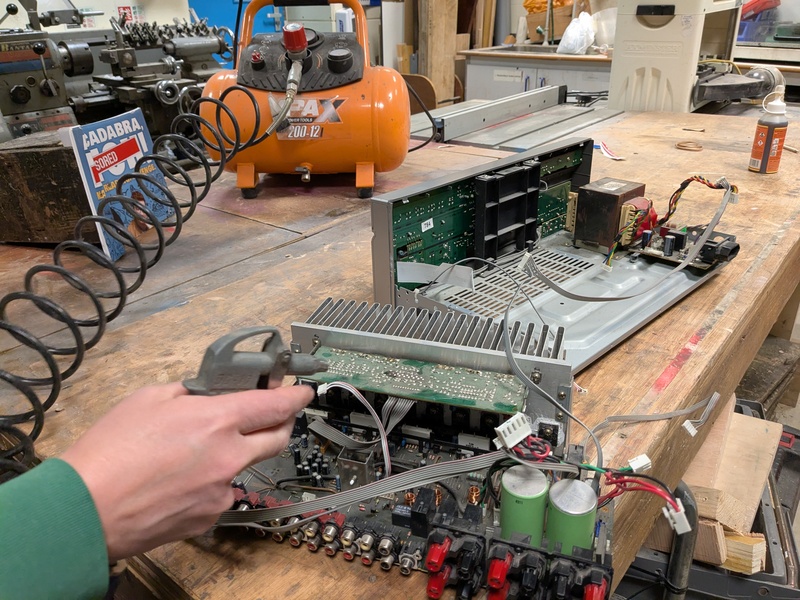
Biohazard removed, Cicely unsoldered the relays from the main board, which needed the board to be removed from the amplifier case. One of the connectors (CNP915) didn't want to undo, but Ivy had the necessary resolve to try using force - turns out she had the correct knack and it levers upwards to disconnect.
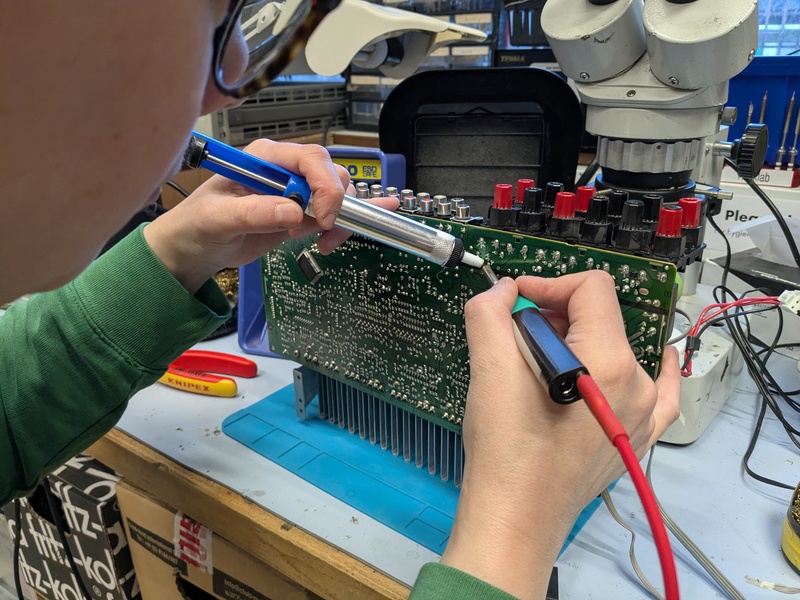
One of the large power supply smoothing capacitors looked a bit suspect, so it was removed for testing. This was difficult, needing a combination of heat from a hot air gun and the soldering iron. It visually looked OK and measured fine so was not replaced. All the other capacitors visually looked OK so weren't tested. (To anyone trying this - be careful handling this part of the circuit board as high power output amplifiers can have a high voltage on their capacitors. Likewise - make sure that the unit is disconnected from the mains supply when opening up).
River and Sila figured a process to open up the relays (levering the case open using two screwdrivers). River knew a technique to clean the contacts using paper soaked in contact cleaner. (Paper is slightly abrasive so is good for this kind of thing).
Funnily enough, shortly after I watched a Mend it Mark video where he repaired relays in the same way. I love his combination of humour, cheekiness and technical acumen, so recommend his channel if you haven't seen it.
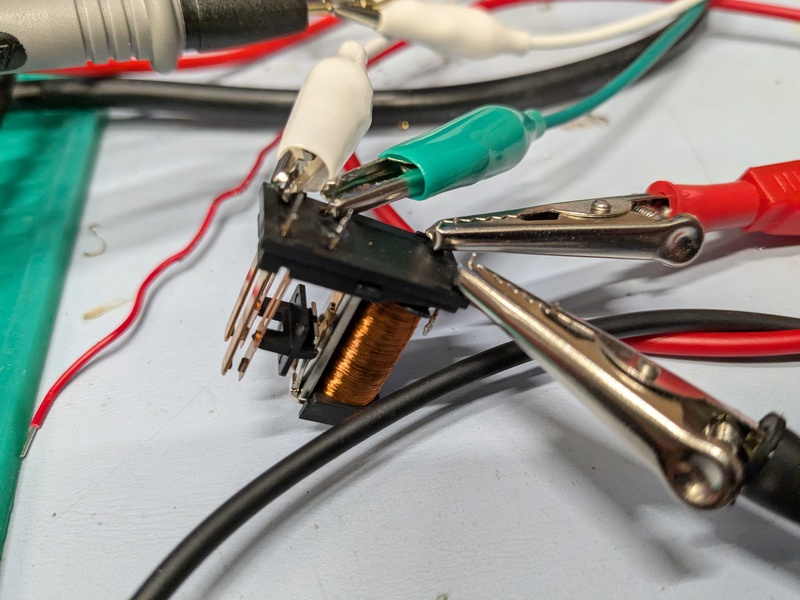
The relays were tested and the contact resistance measured - this turned out to be nice and low after the repair, so they were declared "repaired". Costa glued the relay case back together and they were soldered back onto the board.
A bit of head scratching later to confirm which cable went where and the amplifier was reassembled and back together. But - there was a second fault! Aria found out the cable which people used to connect their laptops also had an intermittent fault, but Jacob soldered new connectors onto the cable and all was fine.
The amplifier has been amplifying fine for a couple of weeks now, so I hope we can declare the repair a success. It's nice to save something from landfill and I hope maybe this post might give someone else the confidence to do the same. (Just make sure it's unplugged from the mains and be careful around the large capacitors).
It was nice that people worked together, and each person had different knacks and knowledge which was brought together to solve a problem.
I think in the geopolitical world of 2026 doing things as a local community is important, so hopefully this repair will have brought music - literally - back into a few people's lives, and have made the world just that tiny little bit better. Let's have more music in this difficult world.
- Relays marked RY701 and RY602 were the problem in this case - one for speaker output A, one for speaker output B.